
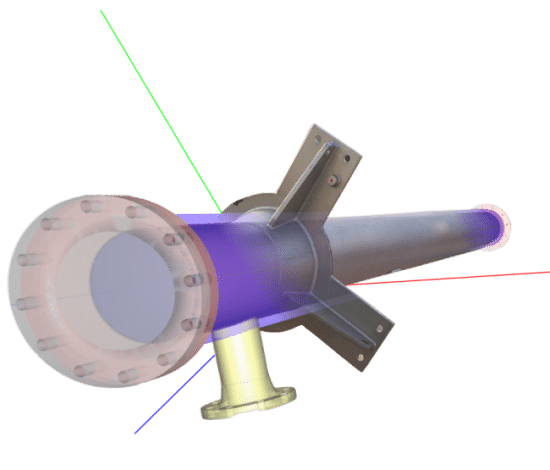
Modern pressure vessel software used in structural design must clearly distinguish between skirt-supported and leg-supported vertical vessels, because their lateral response mechanisms are fundamentally different. In particular, for leg-supported configurations, the governing behavior is often misunderstood: the global shell bending stiffness has only a minor influence on overall deflection and natural frequency, while the dominant contribution comes from the support system itself.
In a skirt-supported vessel, the shell is continuously restrained at the base, allowing the entire vessel to behave like a cantilever beam. In this case, global shell bending is the primary deformation mode, and classical beam theory provides a reasonable approximation of lateral deflection and dynamic response.
For leg-supported vessels, however, the situation changes significantly. The vessel is supported at discrete points, and lateral loads are transmitted through the legs into the foundation. In this configuration, the shell between the supports remains largely undeformed in global bending because it is not acting as the primary load-resisting member. Instead, it behaves more like a rigid or semi-rigid body that transfers inertia forces to the support points.
As a result, the lateral deflection of a leg-supported vessel is governed almost entirely by the flexibility of the legs and their connection details at the shell interface. The legs act as the primary cantilever elements, and their bending stiffness dominates the global response. The shell’s contribution to overall lateral displacement is typically negligible in comparison, except for localized deformation at the attachment points, which may introduce secondary compliance but does not significantly influence global movement.
Similarly, the natural frequency of the system is controlled primarily by the stiffness of the legs and the effective mass of the vessel. Since the shell does not meaningfully participate in global bending deformation, it does not substantially contribute to system flexibility in lateral vibration modes. Instead, the vessel behaves like a concentrated mass supported on flexible columns, and its dynamic characteristics are therefore dictated by the leg stiffness rather than shell rigidity.
This distinction is important because simplified assumptions that treat the vessel as a bending shell can significantly misrepresent its true behavior. A more appropriate conceptual model is a rigid body supported on multiple springs (the legs), where load sharing between legs may be uneven depending on direction of loading and geometry. Under lateral forces, typically only a subset of legs carries the majority of the load, further reducing effective stiffness compared to idealized symmetric assumptions.
From a stability analysis perspective, this has direct implications: small changes in leg stiffness, support geometry, or connection rigidity can have a large impact on both deflection and natural frequency, while changes in shell thickness or shell bending properties often have minimal influence on lateral response for this configuration.
Skirt-supported vessels remain fundamentally different, as their deformation is governed by distributed shell bending and continuous boundary restraint, making shell stiffness the primary driver of both deflection and dynamic behavior.
This issue has been properly addressed in Denis R. Moss “Pressure Vessel Design Manual” ensuring that deflection and dynamic response calculations for leg-supported vessels are based on realistic support flexibility models. This approach correctly captures the fact that, for these systems, the legs – not the shell – govern lateral deflection and natural frequency. It is recommended that engineers use proper vessel software such as VCLAVIS that make use of Denis R. Moss procedures, ensuring results accuracy.