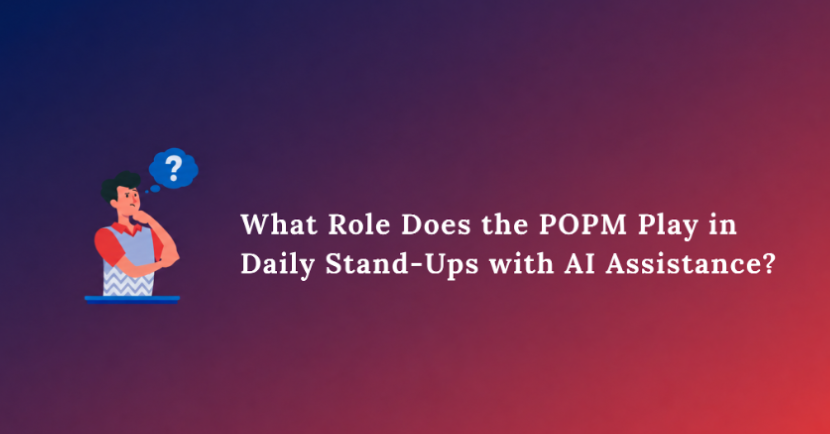
Daily standups help Agile teams align their tasks with organizational goals, priorities, deadlines, and dependencies. It can help a Product Owner/Product Manager (POPM) help understand the progress of development and enable them to help their teams prioritize tasks better, which can help achieve goals more efficiently.
With the advent of AI, Agile teams have witnessed its integration into all aspects of workflow, changing the way in which teams have begun working. Scrum stand-ups have also been transformed because of this. AI can now help in summarizing and transcribing meetings, identifying key points, and highlighting dependencies. This does not only help a POPM save on time, but it also helps in organizing meetings so that they are more meaningful.
Organizations like Scaled Agile provide extensive courses for Product Owners (PO) and Product Managers (PM) in the Scaled Agile Framework, which helps them lead Agile teams effectively. When professionals enroll in the SAFe POPM Course, they will learn important product ownership and management skills and learn to apply the lean-agile methodology to prioritize tasks better for teams. This AI-empowered course will also equip you with the best AI practices and tools to help lead stand-ups and other phases of Agile planning better.
What Does a POPM Do During a Stand-up?
Although the Scrum standup is largely a forum driven by the development team to understand their progress, the POPM can help in the clarification of product priorities and answer queries regarding tasks, requirements, and customer needs whenever necessary. With AI, they can get useful information from the standup discussion to better understand the progress made towards the Sprint Goal and identify topics that can require follow-ups from the team. .
How Can AI Assist in Daily Stand-ups?
Summarise Updates
AI can help in summarizing team members’ updates in stand-up discussions and other collaboration into brief summaries for reference. This helps a POPM get information on items like priorities, delays, and dependencies faster without having to manually refer to it.
Identify Blockers and Dependencies
Blockers can delay the progress of a product, which may slow down the overall development of a product’s vision. AI can analyze stand-up discussions and identify recurring patterns, or repeated dependencies, which help the POPM identify issues that need to be addressed.
Sentiment Analysis to Detect Team Health
By analysing stand-up discussions and other platforms used by Agile teams, AI can detect the productivity level of a team to help understand condition of a team, for instance, if certain team members on the verge of a burnout. These indications help a POPM discern whether workloads need to be redistributed or re-prioritized again and help provide room for discussion to assess issues before they affect the team’ progress.
Align Work with Product Priorities
One of the most important tasks of a POPM is to ensure that the daily tasks done by their team help in the development of the product. AI can analyze stand-up discussions and compare them to other progress metrics such as backlog priorities and roadmap objectives to ensure that team members do the work that enables development that aligns with the business goals.
When tasks are prioritized correctly, it enables teams to work on the items that are important. Scrum Alliance provides comprehensive courses on product ownership that help individuals develop the right skills for facilitating product development in Agile environments. When you sign up for the CSPO Certification Training with Simpliaxis, you will learn the best practices for product backlog management and other aspects of Agile planning.
Track Team Progress Pattern
By continuously analyzing Scrum stand-up discussions, AI can track patterns such as repeated dependencies and recurring problems that arise. It can also track the work patterns of individual team members. This information helps a POPM in prioritization and redistribution of work.
What are the Best AI Practices for a POPM During Stand-Ups?
A POPM should use AI as a tool that assists during stand-ups; they should not be dependent on it to make important decisions that can affect how tasks are prioritized or overall business needs. Listed below are a few practices that can be adopted when using AI assistance during Scrum stand-ups.
Use AI for Preparation
POPM can use AI to read through summaries of past discussions and blockers to help ensure that the meeting remains relevant to it. This also helps them understand how to better prioritize tasks and clarify questions if the need arises during the stand-up.
Verify AI Inputs
After receiving insights from AI tools, a POPM should verify it against other reliable sources of information to ensure that it aligns with business requirements and priorities.
Protect Sensitive Data
AI tools should follow the organizations’ guidelines and ensure that confidential information pertaining to team members, the product, or the development process is not mishandled.
Conclusion
AI is helping POPMs handle stand-ups much more effectively. It has helped make tasks like documentation, identifying blockers, summarizing updates, and ensuring that daily work aligns with the product’s overall vision correctly. By using artificial intelligence responsibly, verifying insights, and protecting sensitive data, stand-ups become meaningful. Better stand-ups enable Agile teams to focus on goals with more clarity, which enhances productivity.
Also deal – Best free ai tools