Every business owner in India today has heard the same advice: ‘Get on the first page of Google.’ But fewer than one in five actually understands what it takes to get there — and what it takes to stay there.
An SEO consultant is not someone who submits your website to directories and waits for magic to happen. A real SEO consultant diagnoses why your website is invisible to the customers who are actively searching for what you offer, builds a plan to fix it, and then executes that plan with discipline across months — because sustainable organic search ranking does not happen in days.
This guide is for Indian business owners who are serious about organic growth. We cover what a qualified SEO consultant actually does, why it matters more now than ever, and how to evaluate whether you are working with someone who delivers results or someone who delivers monthly reports full of metrics that do not grow your revenue.
Let us start with what most agencies will not tell you.
Why SEO Is the Highest-ROI Marketing Investment for Most Indian Businesses
Paid advertising works immediately — you pay for a click, you get a visitor. But the moment you stop paying, the traffic stops. SEO is fundamentally different. A well-ranked page on Google is an asset that generates traffic, leads, and revenue continuously without a cost-per-click attached to every visitor.
The comparison below shows why, for most Indian SMEs, SEO delivers a far superior return on investment over a 12-month horizon than paid advertising alone:
| Comparison Factor | Paid Ads Only | SEO Strategy |
| Traffic source | You pay for every click (Google Ads) | Traffic is free after ranking |
| Cost over time | Stops the moment you pause ads | Compounds and grows month-on-month |
| Trust signal | Labelled as ‘Ad’ by Google | Perceived as organic authority |
| Long-term ROI | Breaks even or negative if CAC is high | 3x to 10x ROI after 6 to 12 months |
| Leads quality | Intent varies by keyword match | High intent — buyer searched specifically |
This does not mean SEO replaces paid advertising. A sophisticated digital strategy runs both in parallel — paid ads for immediate lead flow while SEO builds long-term authority. But for any business that cannot sustain high ad spends indefinitely, SEO is not optional. It is the foundation.
| CONTEXT | India now has over 900 million internet users. Google processes hundreds of millions of searches daily in India alone. The businesses invisible on Google are invisible to the majority of their potential customers — regardless of how good their product or service is. |
What Does an SEO Consultant Actually Do?
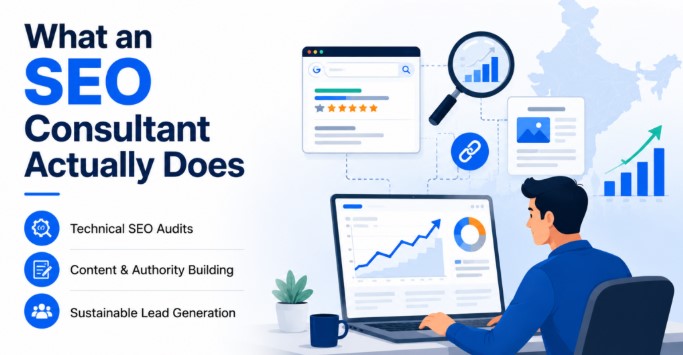
This is the most misunderstood question in digital marketing. Most business owners believe SEO is primarily about keywords and backlinks. In reality, a competent SEO consultant works across six interconnected domains:
- Technical SEO Audit — Fix What Google Cannot Crawl
Before any content or link-building strategy makes sense, the technical foundation of your website must be sound. Google cannot rank a page it cannot crawl, index, or render correctly. A thorough technical audit examines:
- Page speed and Core Web Vitals — Google’s ranking factors that measure real-world user experience (Largest Contentful Paint, Cumulative Layout Shift, Interaction to Next Paint).
- Crawlability — whether Googlebot can access all your important pages, or whether accidental blocks in robots.txt are hiding your content.
- Indexation — confirming that only the pages you want ranked are being indexed, and that duplicate, thin, or low-quality pages are excluded.
- Mobile usability — over 85% of Google searches in India happen on mobile. A website that is not mobile-optimised will not rank competitively.
- Structured data and Schema markup — helping Google understand what your pages are about so it can display rich results (star ratings, FAQs, prices) in the search results.
- Keyword Research — Understanding What Your Customers Actually Search
Good keyword research is not a list of words that describe your business. It is an intelligence exercise that reveals the exact language your customers use when they have a problem you can solve, the volume of people searching for it, the intent behind the search (are they researching, comparing, or ready to buy?), and the realistic difficulty of ranking for those terms given your domain authority.
For Indian businesses, keyword research must account for regional language preferences, city and state-specific searches, Hinglish phrasing, and voice search patterns — especially in Tier 2 and Tier 3 markets where voice input adoption is higher.
- On-Page Optimisation — Making Each Page a Ranking Asset
Every page on your website is an opportunity to rank for specific search queries. On-page optimisation ensures each page is configured to signal maximum relevance to Google for its target keyword cluster. This includes:
- Title tags: The single most influential on-page ranking factor. Each page needs a unique, keyword-rich title under 60 characters that also compels a click.
- Meta descriptions: Not a direct ranking factor but a critical click-through influencer. A well-written meta description acts as ad copy in the search results.
- Heading structure: H1 to H3 hierarchy that signals topical organisation and includes keywords naturally.
- Content depth and E-E-A-T: Google’s 2024 and 2025 algorithm updates have heavily penalised thin content and rewarded pages demonstrating Experience, Expertise, Authoritativeness, and Trustworthiness.
- Internal linking: A strategic internal link structure distributes authority across your website and helps Google discover and rank your deeper pages.
- Content Strategy — Building Topical Authority Over Time
Ranking for one keyword is a tactic. Dominating a topic is a strategy. The most durable SEO results come from building topical authority — publishing a comprehensive body of content around your core subjects such that Google sees your website as the definitive resource in your niche.
A well-executed content strategy for an Indian business includes a pillar page targeting the primary keyword, cluster content addressing every sub-topic and related question, FAQ content targeting voice search and People Also Ask placements, and local content targeting city or region-specific searches relevant to the business.
- Link Building — Earning Authority From Other Websites
A backlink from a credible website to yours is, in Google’s model, a vote of confidence. The more authoritative websites link to you, the more Google trusts your website as an authority in your domain. But not all links are equal — and bad links can actively harm your rankings.
Ethical, effective link building for Indian businesses involves:
- Guest posting on industry publications, business news portals, and niche blogs with genuine editorial standards.
- Digital PR — creating shareable data studies, surveys, or expert commentary that earns organic mentions and links.
- Business directory citations — consistent Name, Address, and Phone Number listings on platforms like Justdial, Sulekha, IndiaMART, and Google Business Profile.
- Broken link reclamation — identifying competitor backlinks pointing to dead pages and offering your superior content as a replacement.
- Local SEO — Dominating Your City and Region
For service businesses, clinics, consultancies, retail stores, and any business with a physical presence, local SEO is often the highest-leverage activity in the entire strategy. When someone in Udaipur searches ‘best CA firm near me’ or ‘digital marketing consultant Rajasthan,’ Google serves results from its local index — driven primarily by Google Business Profile optimisation, review volume and recency, and local citation consistency.
A business with 50 strong Google reviews and a fully optimised GBP listing will consistently outrank a competitor with a superior website but a neglected local presence.
The Complete SEO Audit: What Gets Examined
Before any strategy can be built, a diagnostic audit must be completed. This is the foundation of every serious SEO engagement. Here is what a comprehensive audit covers:
| Audit Area | What Gets Evaluated |
| Technical SEO | Site speed, mobile-friendliness, crawlability, Core Web Vitals, HTTPS, broken links, sitemap |
| On-Page SEO | Title tags, meta descriptions, heading hierarchy (H1 to H3), keyword placement, image alt text |
| Content Quality | Depth, originality, topical authority, E-E-A-T signals, internal linking structure |
| Off-Page SEO | Backlink profile quality, domain authority, toxic link removal, and digital PR opportunities |
| Local SEO | Google Business Profile optimisation, NAP consistency, local citations, reviews |
| Competitor Gap | Keywords competitors rank for that you do not, content gaps, link gap analysis |
| IMPORTANT | An SEO audit without a prioritised action plan is just a report. The value is in knowing which fixes move the needle first — typically technical issues, then on-page optimisation, then content, then link building. Sequence matters enormously for results. |
How Long Does SEO Take? Setting Honest Expectations
This is the question every business owner asks, and where most agencies either lie or overpromise. The honest answer depends on three variables: the current state of your website, the competitiveness of your target keywords, and the consistency of execution.
Here is what a realistic SEO timeline looks like for an Indian SME starting from scratch or from a poor baseline:
Months 1 to 2: Foundation and Technical Fixes
Technical audit completed and critical issues resolved. Keyword research finalised. On-page optimisation of the top 10 to 15 most important pages. Google Analytics 4 and Search Console are configured and tracking correctly. No visible ranking improvements yet — this is normal. The engine is being built.
Months 3 to 4: Content and Authority Building
New content launched targeting medium-difficulty keywords. Internal linking structure overhauled. First backlinks acquired through guest posts and directory citations. Early ranking movements visible for long-tail keywords (low search volume but high intent). Some pages begin entering the top 30 to 50 results.
Months 5 to 6: Traction Begins
Target pages entering the top 10 to 20 results for primary keywords. Organic traffic is beginning to show measurable month-on-month growth. Featured snippet opportunities are beginning to materialise. Local SEO rankings are improving for city and region-specific terms.
Months 7 to 12: Compounding Growth
Core keywords in the top 5 to 10 positions. Organic traffic generates consistent, qualified leads. Domain authority is improving, making future rankings easier to achieve. The strategy enters a compounding phase where each month’s gains build on the last.
| THE TRUTH ABOUT QUICK RESULTS | Any consultant guaranteeing Page 1 rankings in 30 days is either targeting keywords nobody searches for or using black-hat tactics that will eventually trigger a Google penalty. Sustainable SEO takes 4 to 6 months to show material results and 10 to 12 months to fully compound. This is not a flaw — it is the barrier that keeps your competitors out once you are established. |
The 7 Signs You Are Working With the Wrong SEO Agency or Consultant
- They guarantee specific rankings. Google’s algorithm has over 200 factors and changes hundreds of times per year. No one can guarantee a ranking position. Ethical consultants commit to process, transparency, and measurable progress — not guaranteed positions.
- They cannot explain what they are doing in plain language. If your SEO partner cannot answer ‘What did you do this month and why?’ in plain English, they are hiding behind jargon because there is nothing substantive to report.
- They build links in bulk without editorial vetting. 500 backlinks acquired in a month from article directories and link farms is not SEO — it is a penalty waiting to happen. Quality beats quantity every time.
- They report on traffic, not leads. Traffic is a leading indicator. Qualified leads and enquiries are the lagging indicator that actually matters. If your SEO reports do not include lead volume data, the wrong thing is being measured.
- They use the same strategy for every client. An orthopedic clinic in Mumbai and a fashion brand in Delhi do not have the same SEO strategy. If your consultant is not customising their approach to your industry, buyer intent, and geography, you are getting a template, not a strategy.
- They avoid talking about your competitors. Understanding who is ranking above you and why is foundational SEO intelligence. A consultant who never references competitor analysis is not doing competitive SEO.
- Their own website does not rank well. This is the simplest trust test: search for the service they claim to offer in their own city. If they cannot rank themselves, ask why you should trust them to rank you.
Questions to Ask Before Hiring an SEO Consultant in India
Before signing any contract or paying a retainer, ask these five questions:
- Can you show me case studies with before-and-after ranking and traffic data from clients in a similar industry? Generic testimonials are not evidence. Ranked keyword screenshots with traffic growth are.
- What is your process for keyword research, and how do you prioritise which pages to optimise first? This reveals whether they have a systematic methodology or an ad hoc approach.
- How do you approach link building, and can you show me examples of links you have acquired for other clients? This protects you from consultants using black-hat tactics that could eventually penalise your domain.
- How will you measure success, and what does the monthly reporting look like? Insist on seeing a sample report before engaging. It should include keyword position tracking, organic traffic trend, leads from organic search, and a clear actions log.
- What happens in the first 30 days, and when should I realistically expect to see measurable results? The answer to this question reveals both competence and honesty — the two qualities that matter most in a long-term SEO engagement.
Your 90-Day SEO Quick-Start Plan
If you are managing SEO independently before bringing in a consultant, here is the structured 90-day plan that covers the highest-leverage activities:
Days 1 to 20: Technical Foundation
- Run a free Screaming Frog crawl and identify broken links, missing title tags, and duplicate content issues.
- Check Core Web Vitals in Google Search Console. Prioritise Largest Contentful Paint if it exceeds 2.5 seconds.
- Ensure every important page is indexed (use the URL Inspection tool in Search Console).
- Set up Google Analytics 4 with goals tracking organic lead conversions, not just sessions.
Days 21 to 50: On-Page and Content
- Rewrite title tags and meta descriptions for your top 10 most visited pages using your primary keyword in each.
- Add schema markup (LocalBusiness, FAQPage, Service) to relevant pages using Google’s Schema Markup Validator to verify.
- Publish two long-form content pieces (1,500+ words) targeting informational keywords your potential customers search before they are ready to buy.
- Build a logical internal linking structure between your service pages, blog posts, and homepage.
Days 51 to 90: Authority and Local
- Fully optimise your Google Business Profile: complete every section, add 10+ photos, post weekly updates, and request reviews from recent satisfied clients.
- Submit your business to the top 10 Indian business directories (Justdial, Sulekha, IndiaMART, TradeIndia, IndiaBizList) with consistent NAP details.
- Publish one guest article on a relevant Indian industry publication with a natural link back to your site.
- Track your target keyword rankings weekly in Google Search Console and note which pages are improving.
The Bottom Line
SEO is not a technical exercise. It is a business growth strategy. When done correctly, it transforms your website from a digital brochure into a 24-hour lead generation engine — finding and converting customers while you focus on running your business.
The best SEO consultants do not just chase rankings. They understand your business model, your ideal customer’s buying journey, and the keywords that connect your solution to their search. They build an organic presence that compounds in value every month, making it harder for competitors to displace you and cheaper for you to acquire every subsequent customer.
If you are serious about growing your online visibility and building a sustainable, algorithm-proof organic presence, working with an experienced SEO consultant who has done it — not just read about it — is the highest-leverage investment you can make in your digital future.
Google is where your customers are looking. The question is whether they are finding you or your competition.
About the Author
Varun Surana is a business and SEO consultant based in Udaipur, Rajasthan, with over a decade of experience helping Indian SMEs and MSMEs grow their online visibility and revenue. As the founder of Brand Chanakya — a digital marketing agency serving 1,500+ clients since 2016 — Varun brings practitioner-level expertise to every SEO engagement, from technical audits to long-term organic growth strategy. Consult him at varunsurana.in or call +91-97832-07700.